Every Engine & Hybrid Transmission, Explained
There's no single "hybrid", there are four fundamentally different ways to combine gas and electric, and six ways to shift gears. Here's how every major manufacturer does it, and why it matters for the car you buy.

Part One
Internal Combustion Engines
Before hybrids, every car ran on one of these. The big shift of the last decade was "downsizing", replacing big naturally-aspirated V6s and V8s with smaller turbocharged four-cylinders that make similar power from less fuel. Here's how each engine type actually works.
Air is drawn in by piston vacuum alone, with no compressor. Power scales with displacement and RPM, so big NA engines need lots of cubic inches and revs to make horsepower. Toyota and Lexus still favor NA engines (and Atkinson-cycle in hybrids) for proven longevity.
Strengths
- +Proven and long-lived
- +Linear, predictable throttle response
- +Generally lower compression stress
Trade-offs
- −Less torque per liter than a turbo
- −Lower peak efficiency than forced induction
Used by: Toyota, Lexus, Mazda (Skyactiv-G), some Honda engines
Engine Layouts
How the Cylinders Are Arranged
Inline-3 (I3)
Three cylinders in a row, smallest common layout, used in downsized turbos and some hybrid generator engines.
Examples: Ford 1.0 EcoBoost, BMW B38, Toyota M15A
Inline-4 (I4)
The workhorse: four cylinders in a row, naturally balanced enough for mass production. The most common car engine layout worldwide.
Examples: Honda 1.5T, Toyota A25A, Hyundai Smartstream, VW EA888
Inline-6 (I6)
Six in a row, inherently balanced (no secondary vibration), smooth and loved by enthusiasts. Making a comeback after decades of V6 dominance.
Examples: BMW B58, Mercedes M256, Stellantis Hurricane, Mazda e-Skyactiv G 3.3
V6
Two banks of three cylinders in a V, shorter than an inline-6, fits transverse in front-drive cars. Dominated the 1990s–2010s.
Examples: Toyota GR, Honda J35, Nissan VR, GM High Feature
V8
Two banks of four, the classic muscle and truck engine. Being phased into hybrid assist to preserve it against emissions rules.
Examples: Ford 5.0 Coyote, Chevy LT1, Hemi, BMW S65
Boxer (Flat-4 / Flat-6)
Cylinders lie flat in two opposing banks, low center of gravity and naturally balanced. Signature of Subaru and Porsche.
Examples: Subaru FA/FB, Porsche 911 flat-6
Rotary (Wankel)
A triangular rotor spins in an oval chamber instead of pistons, compact, rev-happy, but poor sealing and efficiency historically. Used only by Mazda, now as a generator in the MX-30 PHEV.
Examples: Mazda MX-30 R-EV (rotary generator)
Part Two
The Four Hybrid Architectures
"Hybrid" isn't one technology, it's four fundamentally different ways to combine a gas engine and electric motor(s). The architecture determines how the car feels to drive, how efficient it is, and how it ages. These are the only four that matter.

Two-Motor Hybrid (e-CVT)
Two electric motors, no gearbox
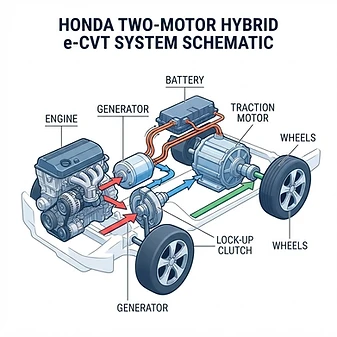
Despite the 'e-CVT' name, there's no belt and no gears to shift. A big traction motor drives the wheels while the gas engine mostly spins a second motor as a generator. At steady highway speeds, a lock-up clutch connects the engine directly to the wheels for efficiency. It's mechanically one of the simplest hybrid drivetrains on the market.
Strengths
- +EV-like smooth acceleration around town
- +No belt or clutch packs to wear out
- +Engine direct-drive at cruise keeps highway MPG strong
Trade-offs
- −Engine revs can feel disconnected from speed under hard throttle

Power-Split Hybrid (Planetary Gearset)
Engine + two motors blended through one gearset
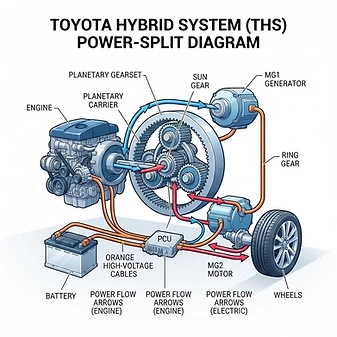
The gas engine and two motor-generators all connect through a single planetary gearset that continuously splits power between the wheels and the battery. There are no clutch packs, no torque converter, and no belt, the 'shifting' is done electrically by varying motor speeds. This is the most widely used hybrid transmission architecture among mass-market automakers.
Strengths
- +Extremely proven and durable, fewest wear parts of any transmission
- +Seamless power delivery with no shift shock
- +Excellent city fuel economy
Trade-offs
- −Droning engine note under heavy acceleration
- −Less engaging feel for enthusiast drivers

Parallel Hybrid (Motor-in-Transmission)
Traditional automatic with an electric motor sandwiched in
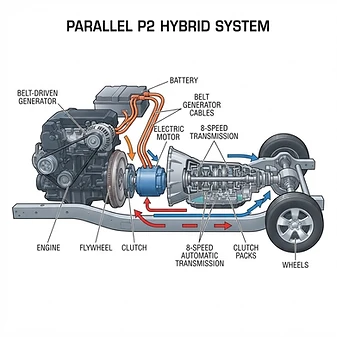
This keeps a conventional automatic transmission, planetary gears, clutch packs and all, and bolts an electric motor between the engine's flywheel and the transmission input. A separate generator on the crankshaft (often belt-driven) handles engine restarts and battery charging. Several truck and SUV hybrids use this layout. It's a totally different concept from power-split or two-motor hybrid systems.
Strengths
- +Familiar shifting feel and strong towing capability
- +Full electric torque through real gears
- +Can drive pure-electric with the engine fully decoupled (PHEV versions)
Trade-offs
- −Most mechanically complex hybrid layout, more parts that can wear
- −Fuel economy gains are smaller than power-split or two-motor systems

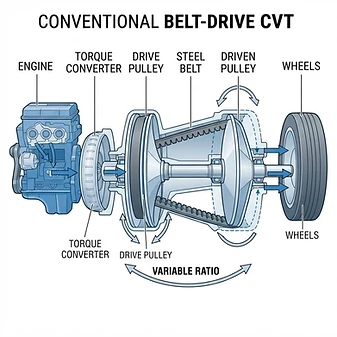
Belt-Drive CVT
Steel belt between two variable pulleys
A steel belt (or chain) runs between two cone-shaped pulleys that squeeze together or spread apart, giving an infinite range of gear ratios instead of fixed gears. This is a *conventional* CVT, completely different from the 'e-CVT' in hybrids, which has no belt at all. The upside is the engine can always sit at its most efficient RPM.
Strengths
- +Excellent fuel economy in daily driving
- +Smooth, no gear hunting or shift shock
Trade-offs
- −'Rubber-band' feel: engine drones while speed catches up
- −The belt is a long-term wear item, especially behind high-torque engines

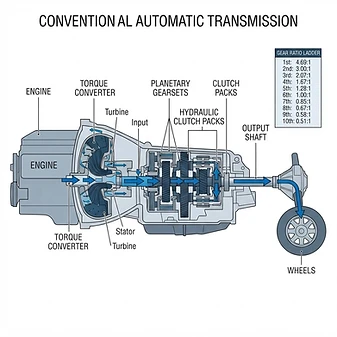
Conventional Automatic
Fixed gears, clutch packs, torque converter
The traditional layout: a torque converter connects the engine to a stack of planetary gearsets, and hydraulic clutch packs engage different combinations to give fixed gear ratios. Modern 8- to 10-speed units shift quickly and keep the engine near its sweet spot.
Strengths
- +Proven, predictable, and strong for towing
- +Direct, connected driving feel
Trade-offs
- −More moving parts than a hybrid power-split system
- −Slightly lower fuel economy than a CVT in stop-and-go driving

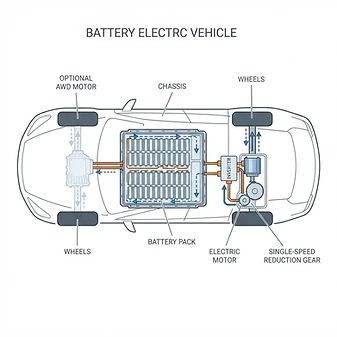
Electric Drive (Single-Speed)
Motor + one reduction gear, no transmission
There's no transmission in the traditional sense. Each motor drives the wheels through a single fixed reduction gear, because electric motors make full torque from zero RPM. No clutches, no belt, no shifting, the fewest moving parts of any drivetrain here.
Strengths
- +Instant torque and perfectly smooth power
- +Nearly zero drivetrain maintenance
- +One-pedal driving with regenerative braking
Trade-offs
- −Efficiency drops noticeably at sustained highway speed
- −No engine sound or shift feel, if that matters to you
Part Three
Which Manufacturer Uses Which System
Filter by architecture to see who uses what, or browse them all. This is the single most confusing thing about shopping for a hybrid, because two cars that both say "hybrid" on the badge can be using completely different technology under the hood.
Toyota / Lexus
Hybrid Synergy Drive (THS)
Power-split through a planetary gearset, the original mass-market hybrid architecture, debuting on the Prius in 1997.
Example Models
Toyota licenses variations to others and is the benchmark for hybrid durability.
Architecture: Power-Split Hybrid (Planetary Gearset)
Ford / Lincoln
Power-Split & PowerBoost
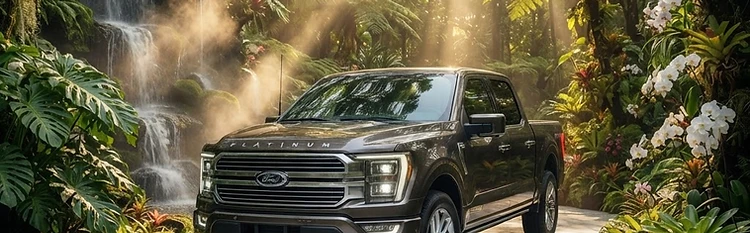
Ford's smaller hybrids use a power-split (co-developed lineage with Toyota's THS). The F-150 PowerBoost is the exception, a P2 motor inside the 10-speed automatic.
Example Models
The F-150 is the only full-size hybrid pickup with the motor built into a conventional automatic.
Architecture: Power-Split Hybrid (Planetary Gearset)
Honda / Acura
Intelligent Multi-Mode Drive (i-MMD)
Two motors and no gearbox, a traction motor drives the wheels, the engine mostly generates, and a lock-up clutch engages for direct highway drive.
Example Models
Honda deliberately avoids the planetary approach Toyota uses.
Architecture: Two-Motor Hybrid (e-CVT)
Hyundai / Kia
Transmission-Mounted Electric Device (TMED)
A motor is bolted to a conventional 6-speed automatic and paired with a clutch, a true parallel hybrid that still shifts through real gears.
Example Models
The 6-speed (not a CVT) is the giveaway that this is a parallel system, not a power-split.
Architecture: Parallel Hybrid (Motor-in-Transmission)
Stellantis (Jeep, Ram, Chrysler)
P2 Plug-in Hybrid
An electric motor sits between the engine and the 8-speed automatic, with a belt-driven generator on the crank for restarts and charging.
Example Models
All PHEVs here, no non-plug-in hybrids in the lineup.
Architecture: Parallel Hybrid (Motor-in-Transmission)
Nissan
e-POWER (Series Hybrid)
The gas engine never drives the wheels, it only spins a generator that feeds the battery and a traction motor. Effectively an EV you never plug in.
Example Models
Nissan's old Altima Hybrid briefly used a licensed Toyota power-split, e-POWER replaced it.
Architecture: Two-Motor Hybrid (e-CVT)
Subaru
e-Boxer / Strong Hybrid
The e-Boxer is a mild P0 hybrid (belt motor assist). The 2026+ TrailSeeker and Toyota-codeveloped strong hybrids use a licensed power-split.
Example Models
Subaru's real hybrid future is a Toyota power-split in a boxer engine bay.
Architecture: Power-Split Hybrid (Planetary Gearset)
BMW
Mild & P2 Hybrid
48V mild-hybrid (B-series) on most models, and a full P2 motor in the ZF 8-speed for plug-in versions (e.g. X5 xDrive50e, 330e).
Example Models
BMW's PHEVs all share the ZF 8-speed + motor recipe.
Architecture: Parallel Hybrid (Motor-in-Transmission)
Mercedes-Benz
ISG Mild & P2/P3 PHEV
EQ Boost (48V belt/ISG) on mild hybrids, and a dedicated motor in the 9G-Tronic for PHEVs like the GLE and S-Class.
Example Models
AMG performance hybrids add an electrically driven turbocharger.
Architecture: Parallel Hybrid (Motor-in-Transmission)
Volkswagen / Audi
DQ PHEV (DCT + Motor)
An electric motor integrates into a dual-clutch transmission (DQ400e 6-speed DCT) for plug-in hybrids; mild hybrids use a 48V belt.
Example Models
The dual-clutch transmission is the tell that this isn't a power-split.
Architecture: Parallel Hybrid (Motor-in-Transmission)
Volvo
T8 Recharge
A motor in the 8-speed Geartronic drives the rear axle via a separate electric motor, with the engine handling the front. Effectively P2 + axle motor.
Example Models
Volvo's approach bolts an electric rear axle onto a P2 front drivetrain.
Architecture: Parallel Hybrid (Motor-in-Transmission)
Mitsubishi
Outlander PHEV
A front motor + generator pair (series-style) with a clutch that can also connect the engine directly, closer to Honda's two-motor concept than to a planetary.
Example Models
One of the earliest PHEVs; architecture is distinct from both Toyota and Honda.
Architecture: Two-Motor Hybrid (e-CVT)
Mazda
M Hybrid (Mild)
A 24V belt-driven mild-hybrid system (P0) assists startup and regeneration, no pure-electric driving.
Example Models
Mazda avoided full hybrids for years, betting on Skyactiv efficiency instead.
Architecture: Parallel Hybrid (Motor-in-Transmission)
General Motors (Chevy, GMC)
Voltec / eAssist
The Volt gen1 used a power-split; gen2 is a dedicated series-parallel. Full-size trucks use eAssist (48V mild hybrid).
Example Models
GM largely shifted from hybrids to full EVs after the Volt.
Architecture: Power-Split Hybrid (Planetary Gearset)
How to Tell Which One You're Buying
If the badge says "Hybrid" and it's a Toyota, Ford (car/SUV), or Subaru strong-hybrid, it's a power-split. No gears shift; the engine just drones.
If it's a Honda or Nissan e-POWER, it's a two-motor system. Feels like an EV around town; the engine runs at whatever RPM it needs.
If it's a Jeep 4xe, Hyundai/Kia, BMW, Mercedes, or VW PHEV, it's a parallel hybrid with a real transmission. You'll feel it shift through gears.
If it's a non-hybrid Nissan, Subaru, or Honda Civic/CR-V/HR-V/Accord, it has a belt CVT. Smooth but droning under hard throttle.
If it's a truck, large SUV, or sports car (non-hybrid), it has a conventional automatic with fixed gears.