Why Gas Cars Still Make More Sense for Ride-Share Drivers
Full-time ride-share is 40,000 miles a year, and the car is the factory. Here is the honest cost-per-mile and uptime math on gas, hybrid and electric, including the 150 hours a year public charging quietly takes.

Most car advice is written for someone who drives 12,000 miles a year and parks in a garage with an outlet on the wall. Ride-share is a different job entirely.
A full-time driver covers roughly 200 miles a shift, five or six days a week. That is 40,000 to 50,000 miles a year. The car is not a lifestyle purchase, it is the factory floor. It earns money only while it is moving, and every hour it spends parked at a charger is an hour the meter is off.
I spent years on a dealership sales floor and I have run this comparison with a lot of working drivers since. The conclusion is not anti-electric. It is narrower and more useful than that: at 40,000 miles a year, the car that wins is the one that spends the most hours earning, and for most drivers that is still a gas hybrid.
The two numbers that decide this
Two things matter more than anything on a spec sheet:
- •Cost per mile to move the car. Fuel or electricity, plus the wear that high mileage accelerates.
- •Hours per year spent refueling. Not dollars. Hours. Because those are hours you cannot accept a ride.
Buyers obsess over the first and almost nobody calculates the second. For a driver, the second is often the bigger number.
Cost per mile at 40,000 miles a year
The assumptions, so you can redo this with your own prices: gasoline at $3.10 a gallon, home electricity at $0.17 per kWh, public DC fast charging at $0.45 per kWh, and 40,000 miles driven.
- •2026 Toyota Prius, 56 mpg combined: 714 gallons, $2,214 a year, 5.5¢ a mile.
- •2026 Toyota Camry, 50 mpg combined as a hybrid-only sedan: 800 gallons, $2,480 a year, 6.2¢ a mile.
- •2026 Toyota Corolla, about 35 mpg combined: 1,143 gallons, $3,543 a year, 8.9¢ a mile.
- •2026 Hyundai Elantra, about 34 mpg combined: 1,176 gallons, $3,647 a year, 9.1¢ a mile.
- •2026 Tesla Model 3, about 3.8 miles per kWh in real mixed driving with climate control on, charged entirely at home: 10,526 kWh, $1,789 a year, 4.5¢ a mile.
- •The same Model 3, charged entirely on public fast chargers: $4,737 a year, 11.8¢ a mile.
- •The same Model 3 on a realistic 30% home and 70% public mix: $3,852 a year, 9.6¢ a mile.
- •2026 Kia EV6, about 3.3 miles per kWh, public charging: $5,455 a year, 13.6¢ a mile.
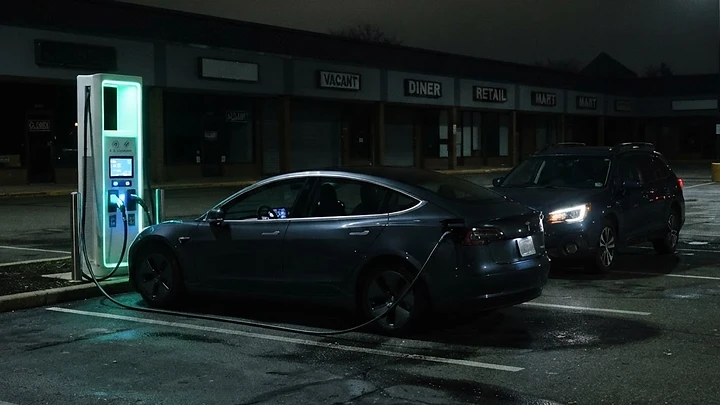
Read that again, because it is the whole article in two lines: a 56-mpg Prius costs 5.5¢ a mile to fuel. A Model 3 fed entirely by public fast chargers costs 11.8¢. The electric car is not cheaper to run in that scenario. It is more than twice as expensive as the hybrid, and pricier than a plain gas Corolla.
The EV only wins the energy argument when the car charges at home overnight, on a residential rate. Roughly half of American renters cannot do that, and a ride-share driver working 10-hour shifts is often not home during the cheap window anyway.

Uptime: the 150-hour tax
Here is the comparison almost nobody runs before signing.
The hybrid. A Camry or Prius covers 550 to 650 miles on a tank. At 200 miles a day that is a fill-up every three days, and the stop itself is about five minutes. Add two minutes for the detour, because there is a station on nearly every corner in America. Across a 250-shift year that is roughly 8 hours of your life spent refueling.
The EV. Starting each shift full at home, a 200-mile day still needs one public session. Real-world, that is 10 to 80 percent on a fast charger in 25 to 35 minutes, plus an 8 to 15 minute detour and whatever queue is at the stall when you arrive. Call it 36 minutes a session, 300 sessions a year: about 180 hours. Even with generous assumptions you land somewhere near 150 hours. Against 8 hours for the hybrid, that is roughly 150 extra hours a year doing something that does not pay.
At a realistic $25 an hour net, that is over $3,500 a year in earning time, before you count the energy cost difference above. It is also why charging during a surge hurts twice: you pay peak electricity rates while missing peak fares.


Convenience is not a small thing
This is not about preferring the smell of gasoline. It is about geographic and temporal coverage.
- •There are more than 100,000 gas stations in the United States and only tens of thousands of DC fast-charge ports. The gasoline network is also where people already are: on the corner, on the way home, open at 3 a.m. with lights on.
- •Reliability. Field studies of public fast charging keep landing near one in five stalls out of service at any given time. A dead pump at a gas station is rare enough to be notable. A dead fast charger is a Tuesday.
- •Payment friction. Gas takes a card in four seconds. Charging means an app, an account, a membership rate you had to remember to activate, and sometimes a phone call because the session will not start.
- •Cold weather. At 20°F you can expect 20 to 30 percent less range, and a cold battery accepts charge more slowly. A gas tank does not care what the weather is.
- •A full car with a passenger in it. Nobody wants to explain to a rider that the trip includes a 30-minute stop, which is why drivers end up charging on their own unpaid time between trips instead.
What 40,000 miles a year does to the car
High mileage is a different stress test than normal ownership, and it changes the math in ways that favor gas.
- •Battery capacity. Expect roughly 10 to 15 percent loss by 120,000 to 150,000 miles on a typical nickel-manganese-cobalt pack, and ride-share cycles are heavy: two to three full charge cycles a week. LFP packs handle daily 100 percent charging better, but they are not universal.
- •Tires. An EV weighs more and delivers full torque from a standstill. You will replace a set every 25,000 to 35,000 miles instead of 45,000 to 50,000. At $900 to $1,100 a set, that is 2.5 to 3.5¢ a mile that never appears in an efficiency rating.
- •Insurance. EV premiums typically run 15 to 30 percent higher, and ride-share coverage is already expensive.
- •Resale at the end. A 200,000-mile Camry or Prius still sells, and often to another driver. A 200,000-mile EV trades at a steep discount because buyers cannot verify the battery's health the way they can hear an engine, and replacing a pack can exceed the car's value. That exit value is real money you get back.
Where the EV is genuinely the better tool
I am not going to pretend otherwise, because the drivers who get burned are the ones who were sold a story instead of a calculation.
- •You have a garage, a Level 2 charger, and drive under 150 miles a day. Now the EV is 4.5¢ a mile, needs no oil changes, and regenerative braking stretches pads to 80,000 miles or more. It is cheaper, quieter and smoother. Buy it.
- •You drive city-only, short trips. Low speeds and regen are where an EV is at its best, and where a gas car is at its worst.
- •Your market pushes for it. A few cities now steer ride-share fleets toward zero-emission vehicles, and some programs throw in charging credits or purchase incentives. Check your own market before you buy anything.
- •You turn the car over before 100,000 miles. Degradation and resale never get the chance to bite.
Notice that none of those say "electric cars are bad." They say the advantage is conditional, and the condition is home charging.
The boring answer that actually pays: a hybrid
For the driver with no garage, a hybrid is the rational purchase, and it is not close.
- •2026 Toyota Camry is hybrid-only now, at 51 city and 53 highway. No plug, 50 mpg, well over 500 miles of range, and no charging stop ever.
- •2026 Toyota Prius is the efficiency champion at 56 mpg combined, and the car the ride-share industry has quietly standardized on for a decade for exactly this reason.
- •2026 Hyundai Elantra and 2026 Toyota Corolla are the cheap-entry play when capital matters more than fuel, at 34 and 35 mpg combined.
A hybrid gives you roughly 60 percent of the fuel savings of a home-charged EV with zero of the uptime cost, and it keeps the resale market that high-mileage EVs lose. If a plug-in hybrid tempts you, be honest with yourself: a Prius Prime only saves money if you actually plug it in every night. Drivers who buy a plug-in and never charge it get worse fuel economy than the plain hybrid.
What I would buy in each situation
- •Apartment, no charger, 200 miles a day: Camry or Prius hybrid. Not a debate.
- •House with a Level 2 charger, under 150 miles a day: Model 3 or EV6, and enjoy the quiet.
- •Mixed use with a home outlet: Prius Prime, but only if you genuinely plug in nightly.
- •Lowest possible entry cost: Corolla or Elantra, and put the savings toward the loan.
- •Cold climate with long shifts: hybrid. Cold is where the EV's worst day and your longest day collide.
The bottom line
Your car is a business asset, and the only metric that matters over a year is how many paid hours it produces. On that metric, gasoline still wins for the majority of full-time ride-share drivers, specifically in hybrid form: 5.5 to 6.2¢ a mile, an eight-hour annual fueling bill, and a resale value that survives 200,000 miles.
An EV can beat that, but only if you can charge it at home overnight. If you cannot, the 150 hours a year you spend at public chargers is the most expensive thing you will buy with this car.
If you are weighing the two more broadly, read Electric vs Gas: The Honest Verdict, see what the car really costs to own, and if you already have a quote in hand, run it through the out-the-door calculator before you agree to anything. And if you are currently driving an EV for ride-share and wondering whether you are the exception, this driver's story is the honest counterpoint.
If the math says go
If you have run your own numbers and driving is worth it, the fastest way in is the app itself. Sign up to drive with Uber and the invite advertises earning at least $1,640 for your first 165 passenger trips in 30 days. Bonus amounts and trip requirements are set by Uber, vary by city, and can change, so read the terms for your market before you count on it. That is my personal referral link: if you sign up and complete the required trips, we both receive a bonus, and it costs you nothing.
Everything else about picking the right car for the job, including the requirements your car has to meet and the per-mile cost of every option, lives in the ride-share driver's guide.
The cars in this story
The real price and honest verdict on each one
- 2026 Toyota PriusCompact Sedan · from $28,550
- 2026 Toyota CamryMid-Size Sedan · from $28,850
- 2026 Toyota CorollaCompact Sedan · from $22,475
- 2026 Dodge ChargerSports Car · from $49,995
More car news

Best Time to Trade In a Car: The 2026 Honest Buyer’s Guide
Wondering when to trade in your car? Discover the optimal timing, market trends, and financial strategies to maximize your vehicle's value in 2026.

Smart Car Buying: Navigating the 2026 Market With Confidence
Master the 2026 car buying market with our honest guide. Learn how to secure financing, avoid hidden fees, and find the right vehicle for your budget today.

Paint Protection Film: Is PPF Worth It in 2026?
Considering paint protection film for your new 2026 vehicle? We break down the costs, benefits, and whether PPF is truly worth the investment for your car.