I Drive Uber. My EV Stopped Making Sense.
I drive for Uber, and my electric car went from a deal to a schedule problem. The charging math, the lost hours, and why a 50 mpg hybrid often wins.
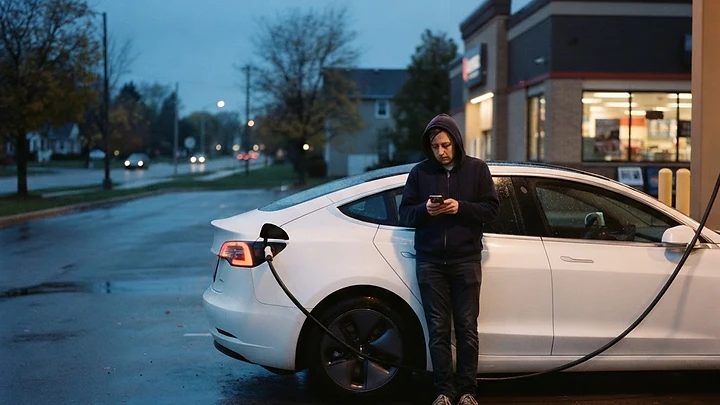
I drive for Uber, and I own an electric car. Those two facts used to feel like a flex. Now they feel like a scheduling problem.
Let me be fair to the car before I'm hard on it. If you drive 8,000 miles a year and plug in at home every night, an electric car is one of the best purchases on the market: quiet, cheap to run, almost nothing to maintain. I still believe that, and nothing in this article is a knock on EVs for normal life.
But rideshare is not normal life. You are not commuting. You are running a small transportation business at 35,000 to 45,000 miles a year, and every hour the car is not moving is an hour you did not get paid. Once I started measuring the car that way, by dollars per paid hour instead of dollars per mile, the EV stopped winning. Not by a little. By enough to change what I drive.
Here is the math I wish someone had put in front of me before I signed.
The assumptions, so you can argue with them: gas at $3.20 a gallon, home electricity at 17 cents a kilowatt-hour delivered, public fast charging at 45 cents, an EV that averages 3.4 miles per kWh in summer and 2.7 in a Michigan winter. Swap in your own numbers. The point of this article is the method, not my particular grid price.
The promise, and why it's real
The pitch is accurate as far as it goes. An EV driven 1,200 miles a week, charged at home for 17 cents a kilowatt-hour, costs about 5 cents a mile in energy. A 30 mpg gas sedan at $3.20 a gallon costs about 11. On paper, that is a $70 a week difference, and over 40,000 miles a year it is real money.
There is more. Regenerative braking means your brake pads last a very long time. No oil changes, no spark plugs, no transmission service. On top of that, the car is genuinely better for passengers: silent, smooth, no engine shudder at every stoplight. My ratings went up when I switched. That part of the story is true.
So why did it fall apart?
Because that version of the math assumes the two things a full-time rideshare driver usually does not have: a place to plug in for free-of-time, and short shifts.
What charging actually costs when you don't have a driveway
Home electricity in much of Michigan runs somewhere between 16 and 20 cents a kilowatt-hour once delivery and fees are on the bill. A public DC fast charger is a different business entirely: 40 to 60 cents a kilowatt-hour is normal in 2026, and pricing by the minute in some states makes it worse, because a slow charge on a cold pack costs more per mile, not less.
Run it at 45 cents and 3.4 miles per kWh, and your energy cost is roughly 13 cents a mile. That is not a saving over a 30 mpg sedan. It is a small loss. In a Michigan February, where the car is doing 2.7 miles per kWh because the cabin heater is working and the pack is cold, you are at about 17 cents a mile, which is worse than a full-size gas sedan.
And this is the exact situation a lot of rideshare drivers are actually in. If you rent your car for the platform, or you live in an apartment, or you park on the street, you have no home charger at all. Every mile you drive was charged at retail. The whole financial case for the car evaporates, and what you are left holding is a heavier, more expensive vehicle with a five-minute fill becoming a forty-minute one.
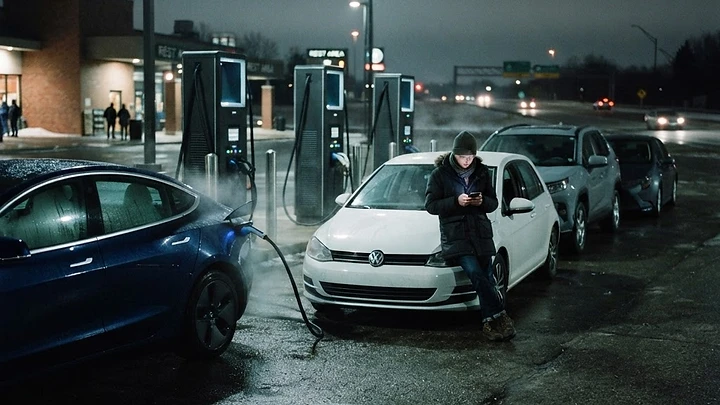

The number that decides it: hours at the charger
This is the part nobody puts in a review, and it is the part that ended the argument for me.
At 1,200 miles a week and 3.4 miles per kWh, you need roughly 350 kilowatt-hours a week. On a home Level 2 charger that is about six hours a night while you sleep, which costs you nothing but a plug. On public fast charging, at a realistic 60 to 70 kilowatts average once the pack tapers, that is five to six hours a week physically attached to a machine, before you count the drive to get there and the wait when both stalls are occupied.
Five and a half hours a week is not an inconvenience. It is inventory. If your net is $20 to $25 an hour after expenses, you just gave away $110 to $140 a week, or $500 to $600 a month, in fares you could not accept because you were waiting on electrons.
Then compare the same week in a 50 mpg hybrid. Twelve hundred miles is 24 gallons. That is four or five stops, maybe twenty minutes total, at any station on any corner, at 3 a.m., in a snowstorm, with no planning whatsoever.
Cost per mile, side by side
Same week, same 1,200 miles. Energy only.
- •Electric, charged at home (17 cents, 3.4 mi/kWh): about 5 cents a mile, roughly $60 a week.
- •Electric, public fast charging (45 cents, 3.4 mi/kWh): about 13 cents a mile, roughly $158 a week.
- •Electric, public charging in winter (2.7 mi/kWh): about 17 cents a mile, roughly $200 a week.
- •Gas sedan, 30 mpg: about 11 cents a mile, roughly $128 a week.
- •Hybrid, 50 mpg: about 6 cents a mile, roughly $77 a week.
Read that list again, because it inverts the story you have heard for ten years. A 50 mpg hybrid costs about the same per mile as an EV on cheap home power, and beats an EV on public charging by a wide margin. It does that without a charger plan, without a range decision, and without a single hour of your working week spent parked.


The bills nobody warns you about
Energy is only half of it. The rest is where a high-mileage EV, and Teslas in particular, quietly get expensive.
Tires. A 4,500 pound car with instant torque eats rubber. EV-specific tires run $250 to $400 each, and at rideshare duty you should expect a set to last 25,000 to 35,000 miles. At 40,000 miles a year that is two sets annually, close to $2,000 to $3,000. A Corolla Hybrid runs $180 to $220 a tire and gets 50,000 to 60,000 miles out of a set. The EV saves you $300 to $450 a year in oil changes and brake work and gives most of it back in rubber.
Insurance. This is the one that surprised me. EVs, and Teslas especially, carry materially higher premiums because a minor collision is a major repair. Aluminum panels, gigacastings, sensors in the bumper, and a small network of certified shops. Expect several hundred to well over a thousand dollars more a year than a comparable gas sedan, and rideshare use pushes it further. Get a quote on the specific car before you commit to the payment.
Downtime after a fender bender. If you drive full time, this is the real risk and nobody talks about it. A certified-shop repair on a Tesla can mean three to six weeks waiting for parts. Three weeks of no driving at $800 to $1,000 a week net is $2,400 to $3,000 gone, from a parking lot scrape. A Camry gets fixed at the shop down the street in four days.
Depreciation. You are putting 40,000 miles a year on it. At 120,000 miles, a used EV scares buyers in a way a used Camry does not, because everyone is pricing in a battery pack that costs five figures to replace out of warranty. Your resale value falls faster precisely because you drove it the way a rideshare driver has to.
Registration. Several states now charge EV owners an extra annual road fee to replace lost gas tax, and it has been climbing. Michigan charges more to register an EV than a gas car. Check your own state before you budget.
Winter, where this job actually happens
Cold is the great equalizer. A heat pump helps, but at 20 degrees you should plan on 20 to 30 percent less range, and rideshare is the worst possible duty cycle for it: constant short trips, the cabin cooling down and reheating at every stop, the pack never warm enough to charge at full speed.
So the winter version of the car is not the version you test drove in September. It is a car that charges slower, goes less far, and needs a plan every single shift. In a warm climate, this section barely applies. In the Midwest, it is half the year.
The earnings cost you can't see
There is a second ledger that never shows up in a fuel comparison: the trips you turn down.
At 80 percent charge you will take anything. At 30 percent, with an airport run offered and a charger you are not sure is working, you start calculating. You decline the long fare. You skip the suburban drop that leaves you fifteen miles from a plug. You finish the shift early because the alternative is charging on your own time at 11 p.m.
Uber and Lyft do not pay you for the rides you did not accept. A hybrid never puts you in that position, and that is worth something real every week, even if it is hard to put a number on.


Where the EV still wins, honestly
I am not telling you an electric car is a bad car. I am telling you it is a bad tool for this specific job in this specific climate without a specific setup. It wins in these cases, and if they describe you, ignore most of this article:
- •You have a garage or a driveway and a real Level 2 charger. Fuel cost drops to about 5 cents a mile and the time cost disappears, because charging happens while you sleep.
- •Your shifts are short. Six hours and 120 miles a day fits comfortably in one overnight charge. A 250-mile day does not.
- •You can top up off the clock, at home, at a depot, or at a free charger near where you eat lunch. If every charge is a detour, the math above is your math.
- •You drive it personally more than you drive it for hire. Low personal mileage plus cheap home power is the ideal EV case, and it is still a great one.
- •You are not in a cold climate. Phoenix and Miami are different businesses from Detroit.
And the reverse: if you rent your vehicle for rideshare, you have none of those advantages. That is the setup that produces the sentence "the EV is useless," and honestly, in that setup, it is.
The best cars for Uber and rideshare in 2026
If I were building a rideshare car from scratch today, with no charger at home and 40,000 miles a year ahead of me:
- •Toyota Camry Hybrid or Corolla Hybrid. 50 mpg, parts on every corner, cheap to insure, indifferent to neglect, and the resale value holds when you are done with it. See the 2026 Camry and the Corolla. This is the boring answer and it is the right one.
- •Honda Civic Hybrid. Same logic, slightly better to drive, similar economics.
- •Hyundai Elantra Hybrid or Sonata Hybrid. Frequently the best value in the class, and the warranty is long. Compare the Elantra and Sonata.
- •Toyota Prius. The rideshare default for fifteen years for a reason (2026 Prius). Buy a used one at 60,000 miles and it will still be working when you are done with this job.
- •If it must be an EV: the largest pack you can afford on an 800-volt architecture, so a stop is fifteen minutes instead of forty. But only if the home charger is real. Without it, you are paying retail for every mile and paying in hours too.
The verdict
The electric car did not get worse. My use of it got more demanding, and the costs that were invisible at 10,000 miles a year became the whole story at 40,000.
If you drive little and charge at home, an EV is genuinely excellent (our EV vs gas breakdown covers that side of the ledger), and I would buy one again for that life. If you drive for a living, especially in a cold state, especially without a driveway, a 50 mpg hybrid will make you more money this year than any electric car on the lot. That is not a fashionable answer. It is the one the arithmetic supports.
One practical note before you decide anything: track one real week first. Write down your actual miles, your actual electric bill increase, and the price of the fast chargers on your usual routes, and time one charging session from plug to 80 percent. If the numbers still work, buy the EV. If they do not, you just saved yourself two years of arguing with a car.
Frequently asked questions
Is an electric car good for Uber or Lyft? It can be, but only if you can charge at home or at a depot. On public fast charging, the energy cost per mile is roughly equal to a 30 mpg gas car, and you lose five or more hours a week waiting. Most full-time drivers without a home charger will do better in a 50 mpg hybrid.
How much does it cost to charge an EV for rideshare driving? At 17 cents a kilowatt-hour at home and 3.4 miles per kWh, about 5 cents a mile, or $60 for a 1,200-mile week. At a public fast charger at 45 cents, about 13 cents a mile, or $158 for the same week. In winter, add roughly 25 percent to both.
Do Teslas make good Uber cars? Riders like them and they are comfortable, quiet and quick. The problem is everything around the car: higher insurance, expensive tires that wear fast at this mileage, long waits at certified body shops after minor damage, and public charging time on your own clock. Good car, difficult business tool.
Is a hybrid better than an EV for rideshare? For a driver doing 35,000 or more miles a year without a home charger, usually yes. You get roughly the same energy cost per mile with none of the time cost, and much cheaper repairs and tires.
Do EV batteries wear out faster if you drive for Uber? Battery packs are holding up better than early predictions suggested, and daily fast charging is harder on them than slow charging. But the risk that matters for a high-mileage driver is financial, not mechanical: an out-of-warranty pack replacement costs five figures, and used buyers price that risk into what they will pay you.
Are there EV incentives for rideshare drivers? Some markets and some platforms offer charging credits or priority matching for electric vehicles, and those are worth checking, because they can change the math. Treat them as a bonus, not a foundation, since they can change or end without notice.
Can I write off charging costs on my taxes? Usually not on top of the standard mileage rate, which is already meant to cover fuel, charging and wear. If you use actual expenses instead, charging and home electricity used for the car can be part of it, and you would need records. This is a tax question, not a car question, so confirm it with a preparer who handles rideshare drivers.
Carummah is independent and takes no payment from manufacturers, dealers or charging networks. The assumptions in this article are stated up front so you can replace them with your own and test the conclusion yourself.
The cars in this story
The real price and honest verdict on each one
- 2026 Dodge ChargerSports Car · from $49,995
- 2026 Toyota CamryMid-Size Sedan · from $28,850
- 2026 Toyota PriusCompact Sedan · from $28,550
- 2026 Toyota CorollaCompact Sedan · from $22,475
More car news


Hybrid vs Plug-in Hybrid: The 2026 Honest Buyer’s Guide
Confused by hybrid options? We break down the real-world costs, reliability, and driving habits to help you choose the right 2026 hybrid for your lifestyle.

Hybrid vs Gas: The 2026 Honest Buyer’s Guide to Savings
Is a hybrid worth the extra cost in 2026? We break down the real-world fuel savings, depreciation, and ownership costs to help you make the right choice.

Solar-Powered Cars: The 2026 Honest Buyer’s Reality Check
Are solar-powered cars worth the hype in 2026? We break down the reality of solar roofs, charging efficiency, and whether they actually save you money.